

Europe's Fault Line
Post-War Weapons Crisis Exercise developed with Mark Galeotti
Europe after the war
Peace on paper, instability in practice.
This exercise explored how the European Union might respond to a post-war surge in illicit weapons flows from Ukraine into Europe. Participants were placed inside a strategic crisis council and forced to balance security, civil liberties, public confidence, and information resilience under mounting political pressure
Scenario
Set in a post-war Ukraine context, the exercise imagined a new European security challenge emerging after the fighting had subsided. The threat came from illegal weapon flows moving out of the conflict zone and into Europe through black market and organised crime networks.
As weapons moved, political pressure intensified, disinformation spread, and national responses began to pull the European Union in competing directions.
Exercise
Participants were convened as a temporary European strategic crisis council tasked with advising the EU's collective response.
They were divided across teams representing two broad policy blocs. One bloc favoured containment, measured action, and greater sensitivity to civil liberties. The other favoured a more security-maximalist response, with stronger policing powers, tighter borders, and a more forceful posture.
Across three policy submission windows, teams had to review developments, debate options, and submit formal policy advice.
Mark selected which proposals moved forward, shaping the course of the scenario and its strategic consequences.
The game lasted 80 mins.
Environment
Participants joined remotely, joined breakout rooms and used Conducttr's simulated channels to monitor events, assess public reaction, and coordinate their response.
The information environment and human domain were simulated by Conducttr, with live facilitation and structured policy submission points shaping progression through the scenario.
Teams used team-based messaging channels for internal collaboration. Breakout rooms enabled real-time coordination, while formal recommendations were submitted through the exercise process for adjudication by Mark.

Strategic Results
The exercise showed how quickly a security crisis can become an information crisis.
Teams succeeded in improving information resilience over the course of play, but they were forced onto the back foot early by a sequence of destabilising developments. Initial violence, Poland's unilateral actions, harassment of Ukrainian diaspora communities across the EU, and a final public intervention all compounded pressure on the Union's response.
The teams' policies helped reduce some of the disinformation, but they also pushed the response toward stronger security measures. In the end, the situation became politically complicated, and restoring stability required more than just operational actions.

Policy Under Pressure
One of the clearest findings was that good operational ideas were not enough by themselves. The strongest submissions combined practical measures with political framing. The more successful teams understood that a credible EU response needed to address enforcement and coordination, while also protecting legitimacy, proportionality, and cohesion.
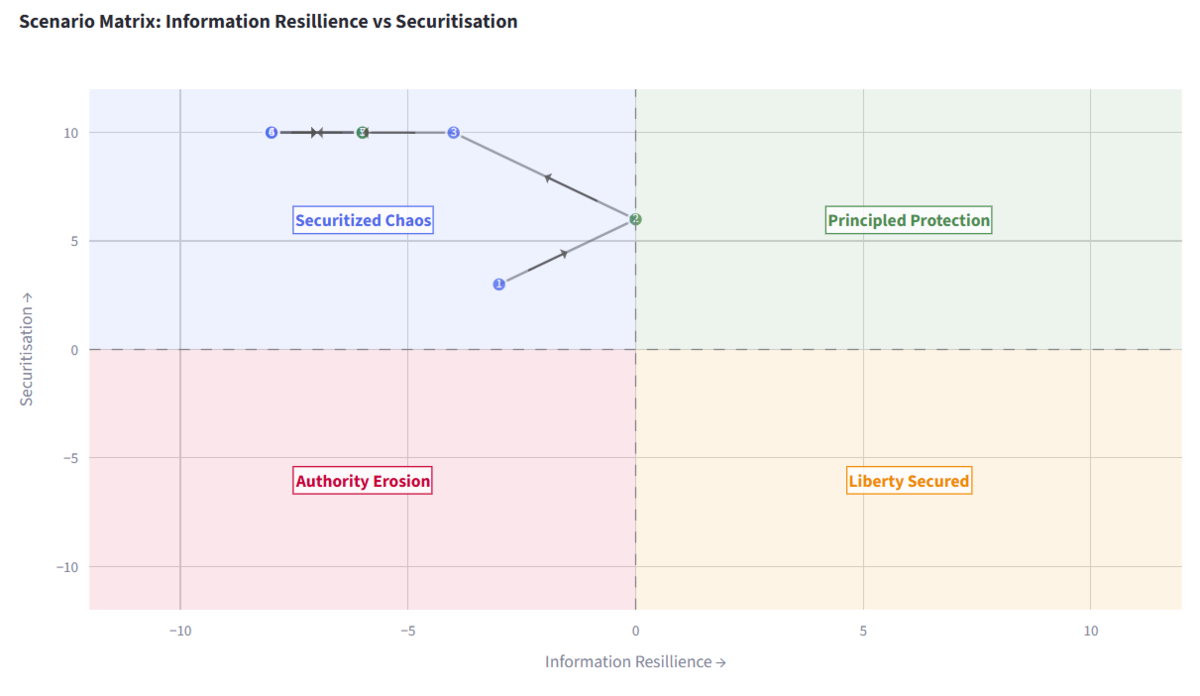
Axes of Uncertainty
The exercise used two measures to show how events and decisions affected Europe's future. The horizontal axis tracked information resilience across the EU. The vertical axis tracked the balance between security and civil liberties. The diagram on the left shows how the exercise tracked during each tick of the simulation as events unfolded and teams submitted policies.
Road to Crisis
This document was issued to registered players before the live participation and introduced the post-war security landscape, illicit weapons flows, and the political tensions shaping the European response.
Download
Download
Policy Under Pressure
One of the clearest findings from the exercise was that good operational ideas were not enough by themselves.
According to Mark Galeotti's assessment, the strongest submissions were those that combined tactical or institutional measures with broader political framing. The more successful teams understood that a credible EU response needed to address not only enforcement and coordination, but also the public narrative around legitimacy, proportionality, and cohesion.
This was not just a test of crisis management. It was a test of whether participants could translate operational thinking into politically viable strategic advice.